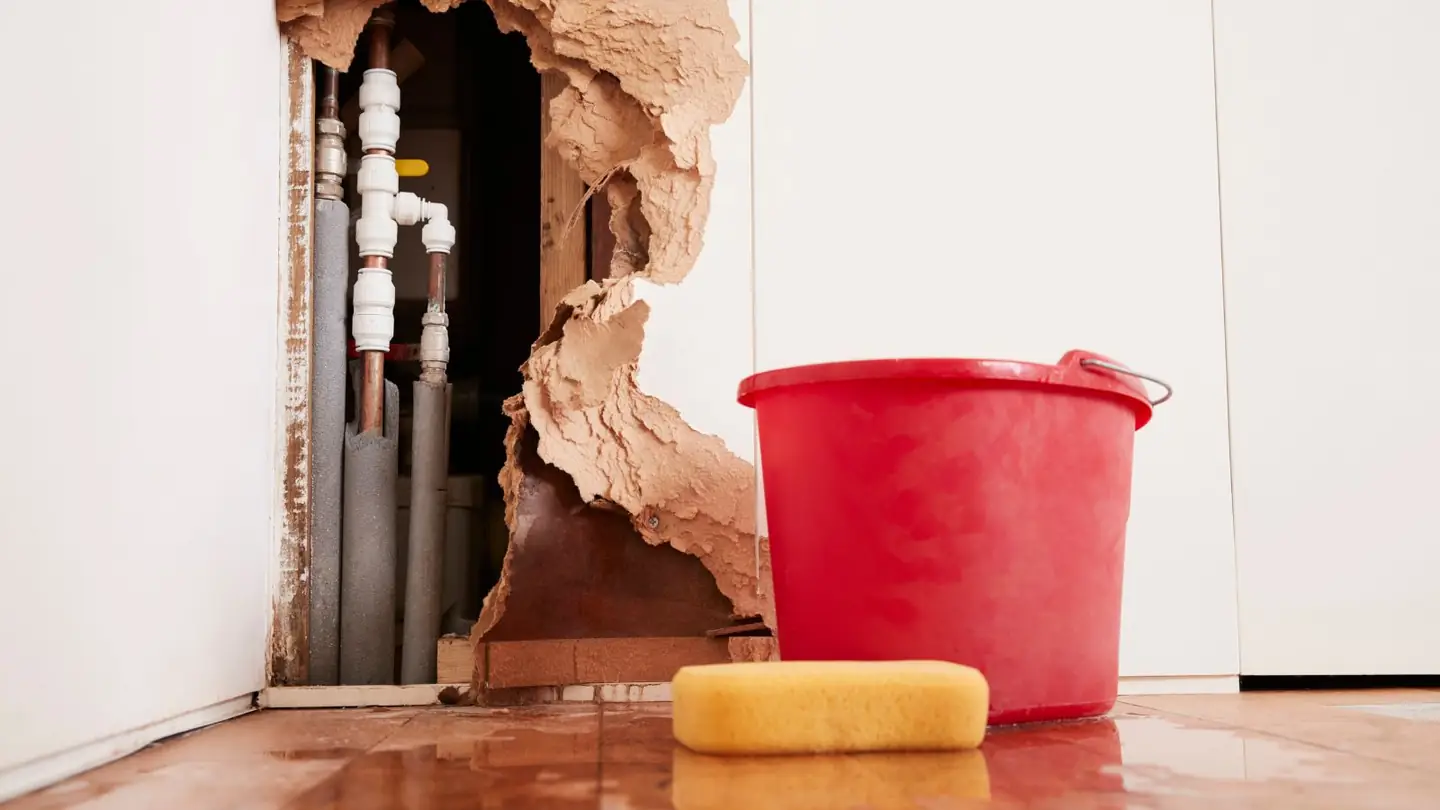
A burst pipe does not wait for a convenient hour, and neither does our dispatch line, which is open 24/7. While you wait, close the main water valve, keep everyone out of rooms where water is near outlets, and lift small valuables off the floor. Turn off the breakers for wet areas only when the panel itself is dry and easy to get to.
Burst pipe water damage in The Colony, TX is the wetting of floors, walls, ceilings and insulation that follows when a pressurized supply line splits or separates and keeps running. The pipe itself is a plumber's job. Pulling out the water and drying the building is ours.
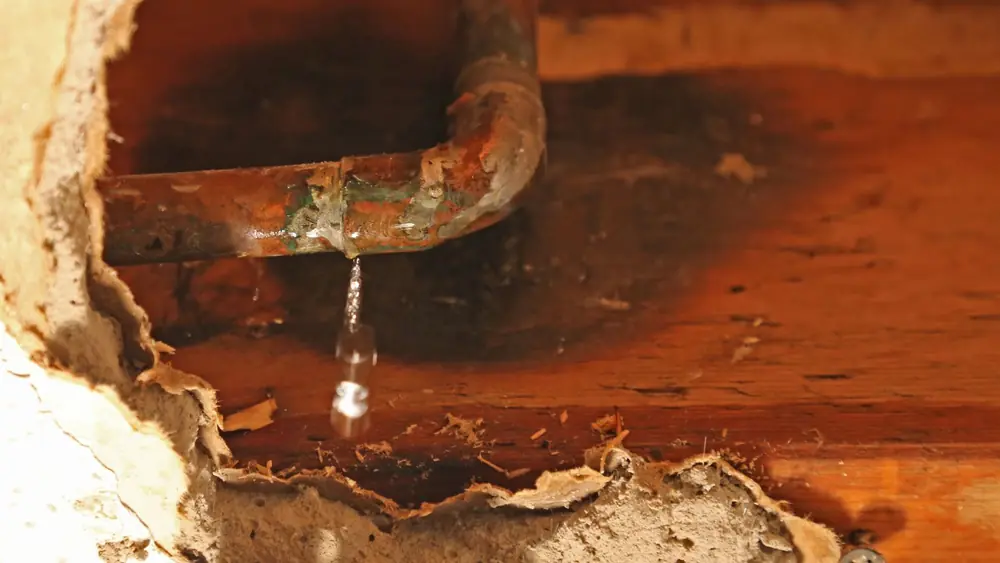
What the water does in the first day
A pressurized line in a wall cavity sends water down the inside of the wall, not out onto the floor. It soaks the insulation first, then the back of the drywall, then the bottom plate and the subfloor under it. Often the room looks fine for a while, which is why people lose hours.
Within the first day, wet fiberglass insulation sags and holds water against the board. Drywall paper softens and the paint begins to bubble. Baseboards swell at the joints. Water that came through a ceiling brings the same pattern down through every layer below it.
Supply lines carry clean water, which is the best case in S500 terms. That window closes as the water sits in damp materials, so a burst line caught early dries far more cheaply than one found the next evening.
Talk to dispatch
Describe what you see and we will tell you what happens next, in plain words, before any work starts.
Why supply lines fail in local houses
Local supply is a blend of groundwater from the city's five wells and surface water that Dallas Water Utilities sells to The Colony, as the water quality report describes it. Water chemistry and pressure vary with the source and the season. If your plumbing is old, ask a licensed plumber whether corroded fittings or an aging pressure regulator could be a weak point in your house.
Most bursts here start at a joint, a clamp, a compression fitting or a thinned stretch of pipe rather than in the middle of a healthy run. A line that has been weeping slowly behind a wall can finally separate under normal pressure. Photograph the failed section before the plumber removes it.
Freezing is a different cause with a different timeline. If the weather is the reason, the story is in our frozen pipe water damage page, because damage from a freeze usually appears at the thaw.
What you see, smell and hear
Many burst pipes announce themselves loudly. Others whisper. Use this list to match what you notice with what it likely means.
- A sound like running water when every tap is off usually means a line is open somewhere in the structure.
- A water meter dial that keeps turning with everything shut off points to a leak after the meter.
- A brown or yellow stain spreading on a ceiling means water has already moved through the insulation above.
- Paint blistering low on a wall, or a baseboard lifting away, suggests water inside that cavity.
- A flat, musty smell in a closet or hall points to wet material that has been hidden for a day or more.
- Warm patches on a floor can mean a hot water line, which is a different repair than a cold supply line.
First-hour safety and shut-off steps
Stopping the water is step one, ahead of any cleanup. Before you step into a soaked room, check it for electrical danger.
- Find the main shut-off valve and turn it fully closed. It is often near the meter at the street, or where the line enters the house, and a hose bib near it is a clue.
- Open one low faucet to drain the pressure that remains in the pipes, if the water in the house is not near outlets.
- Look at the electrical situation before you walk in. If water is near the panel, a ceiling fixture is dripping, or an outlet is wet, use the callout below.
- Photograph the pipe, the water line on the walls, the ceiling and every damaged item before moving anything.
- Call a licensed plumber for the pipe and call the dispatch line for the water. The two jobs can run side by side.
Water and electricity do not mix
If a ceiling is dripping through a light fixture, or water has reached an outlet or the panel, do not touch switches. Stay out of the room.
The breaker is worth flipping only when the panel stays dry and you can walk to it without wading. Should you hear sparking, notice gas, or find the panel out of safe reach, go outside and phone 911 or the utility ahead of us.
City side or your side of the meter
The city owns the line up to the meter. Everything after it belongs to the homeowner. If water is bubbling up in the yard or the street, or if the main in your house is closed and the meter still spins, the problem may be on the city side.
For that, The Colony runs a water and sewer emergency line at 972-625-2741 during business hours and 972-624-4433 after hours. Calling there first can save a plumber's trip. If the failure is inside the house, a licensed plumber is the right call and we handle the water.
Our process after a burst line
We start by finding where the water went, not just where it showed up. Moisture meters read the wall surface and the framing, and a thermal imaging camera shows cooler wet zones behind paint and board. Mapping the loss first keeps the equipment where it does the most good.
Submersible pumps and extraction units remove standing water. Wet insulation that has slumped against the board is usually removed, and drywall is opened or cut above the wet line if it cannot dry in place. Air movers push air across surfaces and into cavities, and LGR dehumidifiers pull moisture out of the air so it does not settle back.
We log readings daily. ANSI/IICRC S500 is the written standard behind those logs, and it is fair to put the same question to every company you interview. Equipment comes out only after every material's readings come back to its dry standard.
Who does what: plumber, restoration crew and city
According to the city's building department, repairs to plumbing, electrical and mechanical systems need permits. It does not publish a rule for water damage repair itself, so call the department before opening walls or replacing piping.
| Job | Who handles it | Why |
|---|---|---|
| Repair or replace the failed pipe | Licensed plumber | Plumbing work needs a trade license and, often, a permit |
| Extract water and dry the structure | Restoration crew | Pumps, meters and dehumidifiers are the tools for it |
| Water leak before the meter | City water and sewer line | The utility owns the line up to the meter |
| Permits for plumbing repairs | City Building Inspections and Permits | Ask the department what your repair requires |
| Claim and coverage questions | Your insurer | Only the policy decides what is covered |
The Colony Building Inspections and Permits is at 6053 Main Street and takes calls at 972-624-3100.
Options and trade-offs
Not every wall has to come open. A small, fast leak into a wall with batt insulation may be dried through small holes with directed airflow. A leak that ran for hours into a ceiling usually needs the board removed so the cavity can dry honestly.
Opening a wall costs less than the repair that follows a hidden problem. Leaving wet board closed costs less today and can cost far more in a month, once staining and odor appear. We explain which one fits your house before we start.
| Situation | Typical approach | Trade-off |
|---|---|---|
| Short leak, wall surface only damp | Drill small holes, dry the cavity with directed air | Less demolition, needs close monitoring |
| Hours of flow into a wall | Remove lower board and wet insulation, dry framing | More repair work, more certainty |
| Water through a ceiling | Cut out saturated board, dry attic insulation | Messier work, avoids sagging and stains |
| Leak ran unnoticed for days | Open affected areas and inspect for mold | Larger scope, hidden damage is found |
What changes the cost
No two burst pipe losses are priced the same, and a number given before anyone sees the house is a guess. These are the factors that move the scope.
| Factor | How it affects the scope |
|---|---|
| How long the water ran | More time means more rooms and deeper saturation |
| Floors and walls reached | Carpet, hardwood, tile and drywall each dry differently |
| Ceiling or attic involvement | Insulation removal and extra access add labor |
| Drying days and equipment count | Larger affected areas need more air movers and dehumidifiers |
| Rebuild needs | Putting back board, paint and trim is its own line of work |
Phone the dispatch line and describe what is wet. We will go over the likely scope with you, then put an actual figure on it for your house once the facts are known. Same-day response is available when we can manage it.
Does insurance cover a burst pipe
TDI points to a burst pipe as a typical sudden and accidental loss, the kind that homeowner and renter coverage often pays for. Slow seepage over time is usually excluded, along with the mold it causes. What your own policy says is what counts.
A claim can be refused when more damage was allowed to happen after the first, which makes the main valve worth closing twice over. Photograph everything, keep receipts for temporary steps, and report the loss soon. Read your policy or ask your insurer, because deadlines and deductibles vary. A repair or removal done before an adjuster sees the damage can complicate things, so ask first.
Mistakes to avoid
- Waiting to see whether it dries. Wet insulation and board stay wet inside the wall.
- Running a household vacuum on standing water near outlets.
- Painting over a ceiling stain before the cavity above has been checked.
- Throwing away the failed pipe section before taking photos.
- Letting a plumber close the wall without a moisture reading.
- Assuming the leak is fixed because the meter stopped. Wet materials still need drying.
Where we work
Our dispatch serves The Colony and nearby cities. If you are across the lake, our Lewisville water damage restoration page covers that area, and our Frisco water damage restoration page covers the west side.
Once the water is out, the work moves to drying and rebuild. For standing water, see emergency water removal. For repairs after the structure is dry, see water damage repair.
Frequently asked questions
Can I get emergency burst pipe help after midnight or on a Sunday in The Colony?
Yes. The dispatch line takes calls day and night, weekends included, so a break in the middle of the night is handled like any weekday call. Same-day response depends on availability. Meanwhile close the main valve, photograph the damage, and have a licensed plumber look at the pipe.
Is the break on the city side or my side of the meter?
The city owns the line up to the meter and you own everything after it. If the main in your house is closed and the meter still moves, call the city water and sewer emergency line, 972-625-2741 during business hours or 972-624-4433 after hours.
How do I find the main water shut-off?
Check near the water meter at the curb, along the outside wall closest to the street, in a garage, or in a utility closet. Turn it fully closed. If it will not turn, tell the plumber and the city line. Find it before you ever need it.
Does insurance cover the pipe or the damage?
Policies usually treat the two differently. Many pay for sudden water damage to the structure and contents, while the pipe repair itself is often excluded. Check your policy and ask your insurer, because wording, deductibles and deadlines vary.
Can I stay in the house after a burst pipe?
Often yes, if the electrical panel is dry and the affected rooms can be closed off. Equipment is loud and runs all day. If water reached outlets, or sewage is involved, ask an electrician or us before you sleep there.
What happens if the leak is inside the wall?
We locate the wet area with moisture meters and a thermal camera, then decide whether small holes or an opened section of board is needed. Wet insulation usually comes out. Drying runs until readings reach the dry standard for the material.
Do I need a permit to repair a burst pipe?
The city says permits are required for repairs to plumbing systems, but the building department does not publish a rule specific to water damage. Call Building Inspections and Permits at 972-624-3100 and ask what your plumber's repair needs.